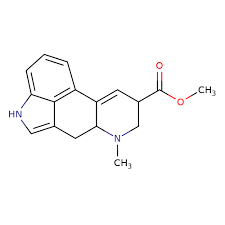
D-Lysergic Acid Methyl Ester, CAS NO.:4579-64-0
D-Lysergic acid methyl ester (CAS 4579-64-0) is a derivative of lysergic acid, often called methyl lysergate, with the chemical formula

C17H18N2O2cap C sub 17 cap H sub 18 cap N sub 2 cap O sub 2
𝐶17𝐻18𝑁2𝑂2
and molar mass ~282.34 g/mol, known for its relation to hallucinogenic compounds like LSD and its action on serotonin receptors, possessing a complex ergoline structure with a methyl ester group.
Key Characteristics:
- Chemical Formula:
C17H18N2O2cap C sub 17 cap H sub 18 cap N sub 2 cap O sub 2
𝐶17𝐻18𝑁2𝑂2
.
- Molar Mass: 282.343 g/mol.
- IUPAC Name: Methyl 6-methyl-9,10-didehydroergoline-8β-carboxylate.
- Structure: An ergoline alkaloid, structurally similar to lysergic acid, featuring a methyl ester at the C-8 position and a characteristic tetracyclic ergoline core.
- Classification: A lysergamide analog, related to powerful psychoactive substances.
Significance & Use:
- Research Chemical: Primarily used in scientific research as an analog to study serotonin receptors (especially 5-HT2A), as it’s closely related to LSD and other ergot alkaloids.
- Precursor/Intermediate: Can serve as a building block or intermediate in the synthesis of other ergoline derivatives.
- Pharmacological Activity: Its effects are explored in neuroscience, although it’s not typically used therapeutically like some related compounds.
In essence, it’s a crucial chemical compound for understanding the pharmacology and synthesis of ergot-derived substances, acting as a key reference point in psychedelic research.


Reviews
There are no reviews yet.